
GTA 6 Xbox leak sparks a rapid community push for an unofficial PC port
Also available in
Grand Theft Auto VI has been out on PS5 and Xbox Series X|S since November 19, with no official PC date from Rockstar Games. Less than a week later, a leaked copy of the Xbox build has turned into a fast-moving reverse-engineering race across open-source repositories and developer Discords.
Up front: GameNode is not linking to any leaked files, repositories, or trackers. This is a summary of what happened, who is working on what, and how far those efforts have gotten as of November 24.
How the Xbox build leaked
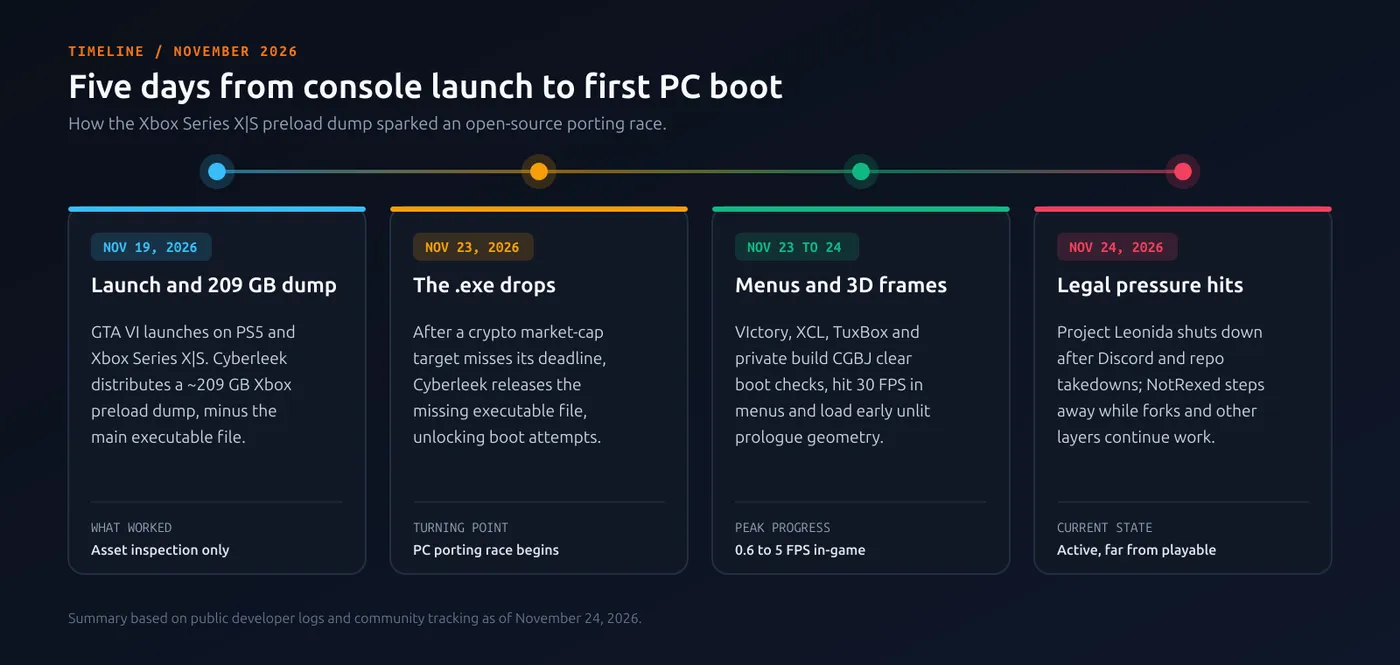
Around launch on November 19, a leaker using the name Cyberleek distributed a roughly 209 GB archive pulled from the retail Xbox Series X|S preload files. At first, there was a catch: the dump did not include the main executable (.exe) needed to boot the game. Modders could inspect raw files and open 3D assets in tools like Blender, and nothing more.
Cyberleek initially tied the executable release to a cryptocurrency market-cap target, with a hard cutoff on November 23 if the goal failed. The target was missed, and Cyberleek published the executable anyway on November 23.
Why progress moved so fast
Getting a PlayStation 3 or Xbox 360 game to boot on PC took years because those consoles ran on completely different CPU architectures. Xbox Series X|S is much closer to a standard desktop computer: it uses an x86-64 processor, a Windows-derived operating system, and a DirectX graphics pipeline.
Because of that shared base, developers do not have to emulate the CPU from scratch. The community quickly split along two main technical paths:
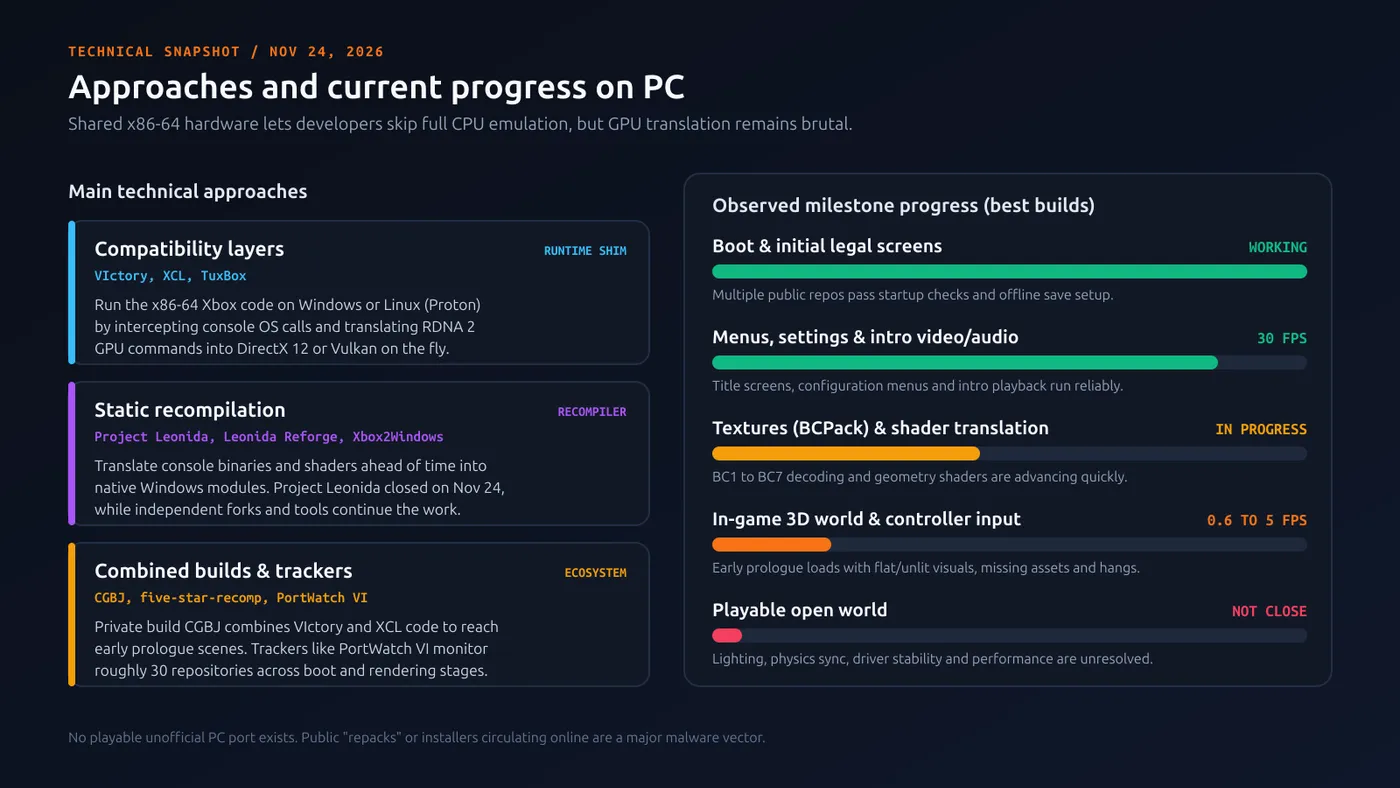
- Compatibility layers: Runtime shims, closer in spirit to Wine or Proton than a classic emulator, that execute the console code on Windows or Linux while intercepting Xbox OS calls and translating AMD RDNA 2 GPU commands to DirectX 12 or Vulkan on the fly.
- Static recompilation: Tools that analyze and translate console binaries and shaders ahead of time into native Windows modules.
The projects and developers involved
Within 24 hours of the executable appearing online, roughly 30 public repositories and private builds were being followed by community trackers such as PortWatch VI. A few names stood out early:
- VIctory (Marvisak): A Rust-based compatibility layer for Windows. Its creator, Marvisak, drew wide attention after livestreaming sessions that pushed past black screens into title menus and intro sequences. Separate forks, including AnyXboxX, also began testing early world geometry and controller input.
- XCL (ivall): Short for Xbox Compatibility Layer, started under the handle ivall. It aims to serve as a broader open-source compatibility layer for Xbox Series X|S software on Windows, pulling in dozens of contributors and getting past startup checks and initial screens.
- TuxBox (brcly): A Linux-first compatibility layer built by brcly and tested through Proton as well as Windows, also reaching early frame output and initial selection prompts.
- CGBJ: A private build combining code from VIctory and XCL. Based on shared footage and tracker notes, it has pushed furthest so far, loading past the menus into early prologue scenes where a player can move with a controller and trigger basic NPC interactions.
- Project Leonida (NotRexed): The most visible static recompilation project, led by a 15-year-old developer going by NotRexed (also known as ItsNotRexed). At its peak, its Discord server approached 180,000 members.
- Xbox2Windows (R0Y00) and five-star-recomp: Other open-source efforts researching Xbox Series static recompilation, PE-to-DLL translation, HLSL-to-DXIL shaders, and early startup milestones.
Where progress actually stands
The headlines make it easy to assume people are already playing GTA 6 on PC. They are not.
Across the furthest open-source layers, startup checks, offline save setup, title menus, settings screens, and intro video playback with audio are working, with menus holding a steady 30 FPS. Contributors have also moved quickly on BCPack (BC1 to BC7) texture decoding and geometry shader translation.
Once a build tries to render the actual 3D world, everything slows to a crawl. In the isolated runs that make it into the opening sequence, frame rates sit around 0.6 to 5 FPS. Lighting and shadows are mostly broken or absent, assets fail to load, and GPU hangs, display driver resets, and memory crashes happen constantly. A stable open world is nowhere close.
Takedowns and Project Leonida shutting down
Take-Two Interactive and Rockstar Games moved quickly. On November 24, Project Leonida shut down abruptly after takedowns hit its Discord server and code repository. NotRexed announced he was stepping away from development for good, pointing to pressure from Rockstar's actions, heavy harassment from older users online, and the strain of balancing a viral project with school and sports.
Closing one repository did not stop the wider scene. Community forks such as Leonida Reforge popped up almost immediately, while VIctory, XCL, TuxBox, and smaller compatibility layers remain active as developers expect further takedowns.
Watch out for fake PC downloads
Security researchers at firms including Malwarebytes, ESET, Avast, and Bitdefender have already flagged tens of thousands of malware detections exploiting the leak. Fake "GTA 6 PC repacks," bogus launchers, and cloned repositories are being used to spread infostealers like Vidar, remote access trojans, and ClickFix PowerShell scams.
There is no playable unofficial PC version of Grand Theft Auto VI available anywhere. Real reverse-engineering projects publish source code for researchers and developers, not pre-built installers or repacks. Anyone waiting to play on PC will still need to wait for Rockstar's official release.
Recent blog posts
Tags